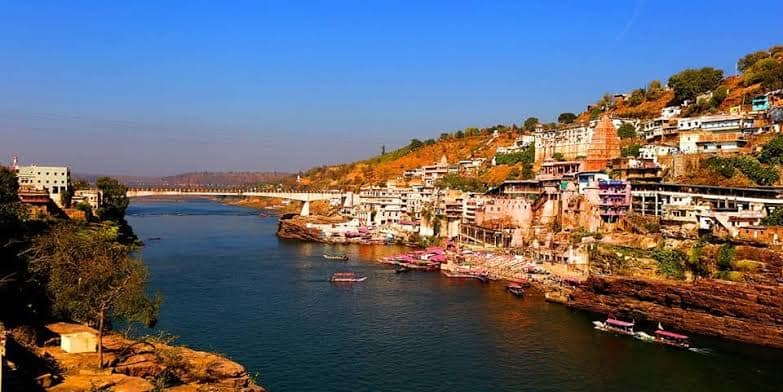
Though the whole of Narmadakhand is considered sacred and a large number of Teerthas have been described in various Puranas, Omkareshwar is the single most important pilgrim centre in the whole Narmada belt. It is one of the twelve Jyotirlingas – the pre-eminent shrines of Lord Shiva. The whole of Narmadakhand is considered to be immanent with the presence of Shiva and it is not difficult to imagine the stature of a place which is a Jyotirlinga and that too on the bank of the Narmada. The main part of Omkareshwar is an island on the Narmada and according to the conventions of the Parikrama, a Parikramavasi cannot cross the river and therefore can visit Omkareshwar island and temple only after completing the Parikrama. Omkareshwar has a huge pilgrim traffic and is a base for hundreds of ascetics.

People do the circumambulation of the Omkar-Parvat (also known as the Mandhata Parvat) which is an up and down walk around the hill and about 6.5 km in length. It is in shape of ‘Om’ as written in Devanagari script, with a small hill acting as ‘Bindu’ of the character ‘Om.’
Omkareshwar has had fame and eminence since antiquity. It was associated with Raja Mandhata (after whom the island and the hill are named) who was a ruler of the Ikshavaku lineage, also called the Suryavansha or Solar Dynasty. He was an ancestor of illustrious kings like Sagar, Bhagirath, Harishchandra Raghu, Dashrath, and Sri Ramachandra.
In the beginning of the last millennium, Omkareshwar, was ruled by chieftains of Bhil lineage. Nathu Bhil, belonging to this line was defeated by a Chauhan ruler in the twelfth century, whose lineage called the Bhilala, ruled for nearly eight centuries till the modern period. The palace, walls, and gates of this era can still be seen on the Omkar Parvat.

Just at the foot of the Jyotirlinga temple is the cave called ‘Guru Gufa’ where Sri Govindapada, the Guru of the great eighth century philosopher and founder of the Dashanaami (ten schools) Sanyasa tradition – Sri Sankara – lived. Sri Govindapada was the disciple of Sri Gaudapada, famous in the Vedantic tradition for his work ‘Mandukya Karika’ based on the Mandukya Upanishad. Sri Sankara, had walked all the way from Kerala, a distance of nearly 2000 kilometres, to this place and met his Guru. It is said that when the Guru asked him for his identity he replied in verse, which is famous as ‘Nirvana-Shatakam’ having the refrain that he was of the nature of the Pure Consciousness – ‘Chidananda Rupah Shivoham Shivoham.’ Sankara also composed the famous hymn, the ‘Narmada-Ashtakam’ (Tvadiya Pada Pankajam, Namami Devi Narmade) well-known across the whole of Narmadakhand, among ascetics and commoners alike. There is a story that once his Guru was in deep Samadhi in his cave, a sudden overflow occurred in the Narmada, whereupon Sankara prayed to her to be seated in a small receptacle, and not cause a deluge.

The Omkar Parvat is also known as the Shivapuri and has numerous temples like the Rinmukteshwar temple – where dal (lentil) is offered and thereby one is freed of the burden of any debts one unwittingly or unavoidably could not repay. The Omkar Parvat also has Gauri-Somnath temple, Ma Rajajeshwari temple, Sri Siddhanath temple, Pataali Hanuman temple and several other temples. There is also a huge statue of Lord Shiva on the hill top of the Omkar-Parvat Parikrama path. On the whole of the Parikrama path, the MP state tourism has placed display boards with verses of the Srimad Bhagwat-Gita. One can take stairs from Kaveri river side to Gauri-Somnath temple (about 250 stairs) and also down to the other side.

It is common to do a boat Parikrama around the Omkar Parvat. The Omkar Parvat slopes down from east to west and has a height of around 500 feet from the river level on the eastern end. Towards the west, the height gradually gets reduced till one reaches the Sangam Ghat, where Narmada, and Kaveri flowing from the north meet.
According to the conventions of Parikrama even Kaveri cannot be crossed as it is considered tantamount to crossing Narmada which must not be done. The reason lies in the fact that even though the Kaveri meets Narmada a few miles before the Omkar Parvat, the legend goes that Kaveri separated from Narmada due to some misunderstanding between the two, before eventually resolving the differences to unite again. This second union is known as the ‘Sangam Ghat’ which is at the western end of the Omkar Parvat. Kaveri, coming from the northern side of the island, flows with considerable speed, and at the Sangam ghat, where the two streams meet, there is a perpetual sound that can be clearly heard at night even from a distance of half a mile or more.
Due to the Omkareshwar dam and the water controlled by it, the flow of Narmada at Omkareshwar is often seen reduced to a pale shadow of its usual self. Quite often as much as half of the river bed can be seen with hardly any water flow. Surely there are technical reasons for this but one cannot help wishing to see Narmada in her full flow and majesty at the most important place and pilgrim-centre in whole of its trajectory.

On the eastern part of the Omkar Parvat there was a spot called ‘Bhrigu-Paat’ where, it is said, there was a hoary tradition, that ascetics who, on account of bodily ailments, did not feel the need to continue in bodily existence any longer, would jump off a few hundred feet below and end their mortal existence. The is no longer in practice now.
There are foot-bridges that connect the Mandhata island with the southern bank. The southern bank has areas traditionally known as the Vishnupuri and the Brahmapuri. They were said to be separated by a stream called Kapila. This side also has a number of temples including the great Mamaleshwar (also called Amaleshwar) which too is considered equal in standing as the Omkar Jyotirlinga. There were several priests appointed by Ahilyabai Holkar at Mamaleshwar and entrusted with the task of making ‘Parthiv’ (clay-made) Shiva-Lingas. There are several other temples like the Vishnu temple and the Kashi Viswanath temple on the southern bank.
There are numerous ashrams along the Omkar Parvat Parikrama path like the Omkar Math founded by renowned Yogi Sri Sitaram Omkarnath, Ramakrishna Mission Sadhan Kutir, also known as ‘Safed Kutiya’, Ma Anandamayi Ashram which also runs a school and hostel, ashram of Dhuniwale Dadaji tradition, Barfani Ashram and several others. There are also some monks involved in humanitarian service activities besides their own Sadhana.
Omkareshwar has a big monastic ashram on its southern bank called the ‘Markandeya Sanyasa Ashram’ that was established by much revered saint and Vedanta scholar Swami Ramananda – not to be confused with Swami Ramananda of the medieval period in whose name the Vaishnavite Ramanandi Sampraday has a pronounced presence in north and central India and to which tradition belonged Kabirdas, Goswami Tulsidas, and many other eminent saints in last six centuries or so. The Markandeya Sanyasa Ashram has several centres in Narmadakhand including the Turiya Ashram in Amarkantak. It has a very large number of Sanyasis and there is a general ambience of rich scholarship in the Vedanta philosophy. Many Sanyasis from all parts of the country visit here to take lessons in various aspects of the Vedanta philosophy.
The Department of Culture of the Madhya Pradesh Government has formed a Trust called ‘Acharya Sankara Nyasa’ and through it multi-dimensional programs for scholarship of Vedanta philosophy and honouring the memory of Acharya Sankara are being undertaken. The Trust has installed a 108 feet statue of the great Acharya at the ‘Mandhata Parvat’ and is also developing a museum and an academy aimed at scholarship in the area of Advaita Vedanta, the philosophical thought expounded by Acharya Sankara. This ambitious project has an estimated budget of around Rs. 2000 Cr and as of 2025 the work has made considerable progress.
Just a couple of miles on the road off the southern bank, start an array of hotels, lodges, and Dharmashalas which offer places to stay. The MP State Tourism also runs its set-up. There is quite a large establishment, with more than 100 well-maintained rooms for pilgrims, run by Shree Gajanan Maharaj Sansthan Shegaon, which also runs similar centres in other places like Pandhapur, Tryambakeshwar, and the biggest of all at Shegaon.
The Omkareshwar region has the highest pilgrim traffic in whole of Narmadakhand and teems with tens of thousands of devotees on special days like Amavasyas, Poornimas, Shravan Somwars (Mondays in the month of Shravan that are considered as particularly auspicious for the worship of Lord Shiva) and even more on Narmada Jayanti and Mahashivaratri.
Omkareshwar vibrates with a spirit of its own from early morning till late night and people who visit here and perform the Omkar Parvat Parikrama, or spend a night in the area, invariably report their experience as nothing short of ethereal. Upon reaching Omkareshwar one almost gets a feeling that one has reached a place which is in this world and yet in some way not a part of it – a feeling one might get to varying levels in some other sacred places of antiquity like Kedarnath, Gangotri, Vrindavan or Varanasi. At Omkareshwar one almost feels that the place would have been more or less the same several centuries back and one feels an unmistakable connect with the Unchanging. While the Narmadakhand is a replete with jewels, Omkareshwar is undoubtedly its crest-jewel.
Next Chapter: Between Omkareshwar to Maheshwar and the Story of Ahilyabai Holkar