Nareshwar and Sri Rang Avadhoot
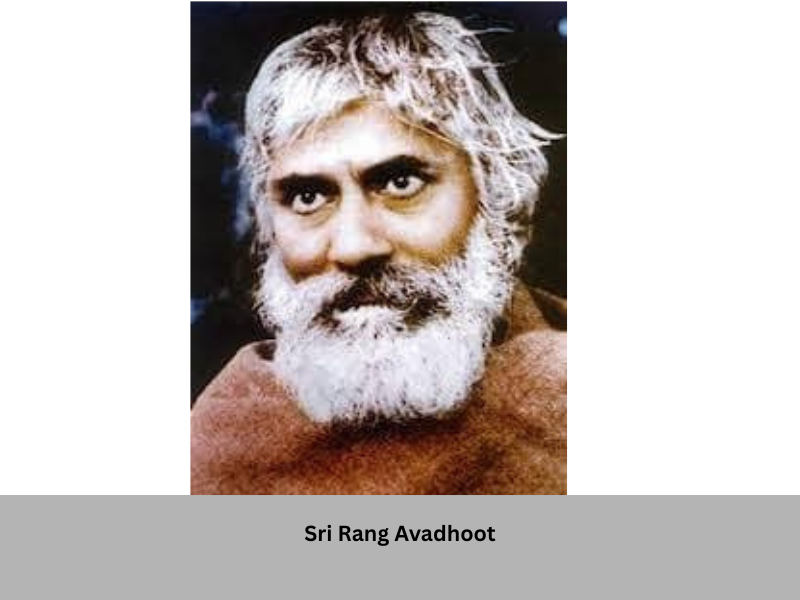
After Malsar, which is on the northern bank, a very important place on the same side is Nareswar, which has the ashram of the renowned saint Sri Rang Avadhut, a disciple of Swami Vasudevananda Saraswati (Tembe Swami). It has a big temple complex visited by a very large number of people everyday. The river flows in the southern direction at Nareshwar. The bank here are sandy, much like the seashore.
Sri Rang Avadhoot, belonging to the Dattatreya tradition, is a highly revered figure in Gujarat and Maharasthra. Born Pandurang Vitthalapant Valame in 1898, in a Maharashtrian Brahmin family in Godhra in Gujarat, he met his Guru at a very young age and was greatly attracted towards the ideals of a deep spiritual life.
After completing his graduation from the Gujarat Vidyapeeth, founded by Mahatma Gandhi during the non-cooperation movement, he briefly worked in Navjeevan Trust, the chief publication centre for Gandhian thought, and later taught Sanskrit in a school which occasioned him to write a book on Sanskrit grammar.
He was a polyglot and a widely read person, interested in best of world literature besides scriptures and writings on spiritual themes. Among foreign thinkers and authors, Leo Tolstoy interested him particularly. Along with the acclaimed Gujarati writer and freedom-fighter Narhari Parikh, he translated into Gujarati, the great Russian’s 1886 work ‘What is to be done?’ – an English title also used for another famous Russian tract of a later date by Vladmir Lenin. He also translated Ernest Crosby’s well-known book ‘Tolstoy as a School-Master’ into Gujarati.
In 1925 he settled at Nareshwar and spent more than four decades there. He performed the Narmada Parikrama twice, in 1927 and 1930 – the first one in mere 108 days. He continued to employ his phenomenal literary talents in authoring more than 40 more books. He composed a large number of devotional songs compiled as ‘Avadhooti Anand.’ He wrote on his Guru, Swami Vasudevananda Saraswati (‘Guruleelasmriti’ and ‘Vasudevasaptashati’) as also on the traditional scriptures like the Upanishads and the Vishnu Purana. He did a verse translation of the Bhagwadgita titled ‘Sangeetgeeta.’ He collected and published Marathi Abhangas (devotional hymns) in form of ‘Rangtarang’ and authored ‘Ranghridayam,’ a work consisting of hymns on Bhakti (devotion) and Jnana (knowledge). He also wrote a 52 stanza poem on Sri Dattatreya titled ‘Dattabavani’ and another work titled ‘Nareshwar-Mahatmya’ on Nareshwar.
His mother also lived with him at Nareshwar till she passed away just a year before he did. Sri Rang Avadhoot left his mortal body in 1968 at Haridwar but was cremated at Nareshwar. The place has become inseparable with the name and spirit of this great saint.
In Gujarat, Narmada makes a number of islands by dividing itself into two streams for short distances before uniting again. One such island which comes not far away from Rajpipla town is the Vyasbet (the word ‘bet’ meaning island in Gujarati.) It is said that Sri Veda Vyasa had stayed here. Just south of Vyasbet is the Shukadevteertha, named after Shukdeva, son of Veda Vyasa, who also did Tapasya here. There is very old temple at Shukadevteertha.
Another famous island that follows is Kabirbad, which has a very great Banyan tree. The place is said to have been visited by the great saint Kabirdas. Just south of Kabirvad is the town Jhagadia where there are several ashrams. Then follows another island, called the Gowalibet.
Bharuch – the last major town on Narmada
From Vadodara, Narmada flows into the last district on its trajectory – Bharuch. The town of Bharuch (with its ancient name of Bhrigu-Kachha was the place of Tapasya of the great sage Bhrigu) is on the northern bank. It is said that it was here that Raja Bali held his Yagna where Vishnu incarnated as a ‘Vamana’ – one of the ‘Dash Avataras’ – though this legend is also associated with a place called Bilthari in Narsinghpur district. The town once served as an important port and was frequented by tradesmen from Middle East, Egypt, and Europe. It was at that time known to the outside tradesmen as Barygaza. On account of its importance as a trading centre, the Narmada too remained well-known to the outside world as affirmed by the references in the Periplus as well Ptolemy’s works. The development of Bharuch as a port instead of any others on western Gujarat is quite easy to understand. It had always been more expensive to ferry goods through land routes than water. So Bharuch on the eastern side of the Gulf of Cambay was of great advantage as lots of good for trading from inland regions were routed through the Narmada. In the later times the name Broach also struck to the city. There are still Parsis from the city who use the surname Broacha.
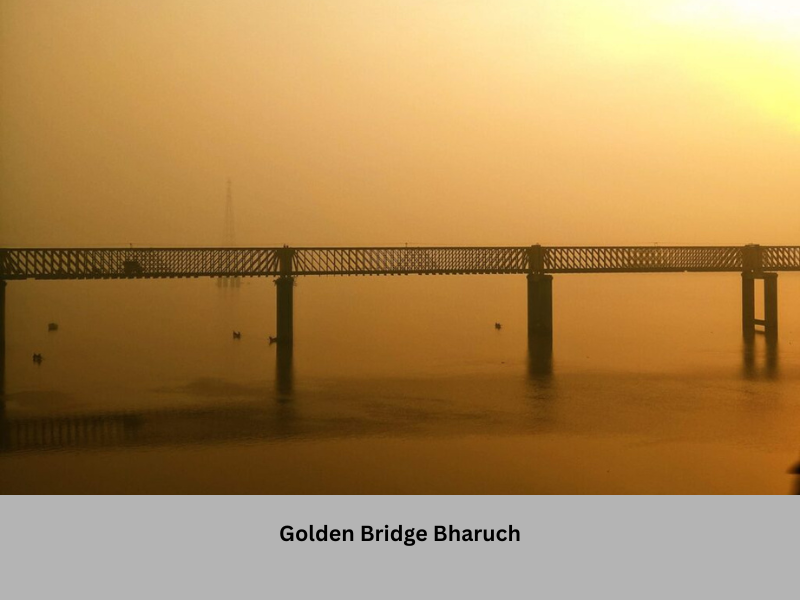
There is a bridge on the Narmada, from Bharuch to the southern bank, constructed in 1881 known as the Golden Bridge. Today one can reach the industrial complex of Ankaleswar, which is a few miles south of Bharuch, through this bridge. Ankaleshwar is a thriving industrial centre with more than a thousand plants, mostly of chemicals, and also has a sizeable petroleum industry.
It was the Golden Bridge that was used by Mahatma Gandhi and hundreds who followed him to cross the Narmada in the Dandi March in 1930. Dandi is further south, located in the Navsari district, which also has a large percentage of tribal population. Navsari is where the first Parsi immigrants who came to India settled down more than a millennium back. It is very interesting to note that the name Navsari (literally meaning ‘New Sari’) is derived from the Iranian town of Sari from where the first set of immigrants had come. In a new land they had hoped and wished to create their lost homeland. History has validated the faith they had reposed in this far-off land where they sought to make their new home.
Uniting with the sea – Reva Sangam
Since Bharuch is almost at the end of the Narmada’s trajectory (about 50 km away from the sea,) those who do Parikrama by vehicles have their vehicles crossed over here. On the southern side the river has to be crossed from the village of Vimaleshwar, also called Vamaleshwar, on boats. The road from Ankaleshwar till Hansot is called the Dandi Path.’ After Hansot one has to leave the ‘Dandi Path’ to proceed a few miles more to reach Vimaleshwar. At Vimaleshwar there are several temples and hundreds of pilgrims can be seen resting and waiting for boats. Most wait for long hours or even more than a day to get a place in the boat to cross the sea to reach the northern bank. Several of them come by buses. Of late a lot of arrangements for hosting Parikramavasis have come up in this place.
To cross over from the southern bank to the northern one has to sail 40 km and in between this is where place of Narmada’s union with the sea is marked known as ‘Rewa-Sangam.’ The Parikramavasis have to book the boats which ferry them across the waters in about 4 to 5 hours (earlier it used to take eight hours.) At the middle of this, they offer their worship to Narmada Devi. The regular boat services for Parikramavasis is usually not available between ‘Akshay Tritiya’ in the summers to Deepawali. They cross over to Mithitalai on the northern bank which is very close to the huge industrial area of Dahej, which is said to have been a place of Tapasya of Rishi Dadhichi.
To the west of Vimaleshwar and Mithitalai is the Gulf of Cambay (Khambaat ki Khaadi) and therefore further westward is located the Saurashtra region, separated from Bharuch district and this side of the land by the Gulf. A fact, not widely known, is that Gujarat has the largest coastline among all Indian states. It also has a multiple ports that cater to the increased trade and commerce. The old seaport town of Gogha is located directly in front of Vimaleshwar. It was an important port, flourishing for more than a millennium, until overtaken by the Bhavnagar port, some distance north of it.
Narmada – A Mother to Millions
The Narmada flows more than 1100 km in MP and only about 200 km in Gujarat – Maharashtra also overlaps with this on the southern bank. The Gujarat part has a large number of temples and ashrams, particularly after the Sardar Sarovar, even in a much smaller area chiefly on account of topographical advantage and greater accessibility. There have been important recent changes too. The Statue of Unity has spurred a whole new traffic of secular tourism that was quite insignificant till now in the Narmada region, that had been predominantly marked by travels of pilgrims from distant places and local devotees. After the ‘Statue of Unity’ has come into being, there have cropped up hotels and resorts in the area around Kevadiya. Some commercial atmosphere due to these changes is clearly noticeable (who would have earlier thought of MacDonalds on Narmada bank!) But most of such tourists flocking only to see the famed Statue, return home, perhaps not much imbued in the magical charm of the Narmadakhand.
As far as the people living on the bank of this great mother-river is concerned, their life almost unimaginable without her. One could say she is present in their very breath and has an overarching effect on their lives. They feel a great sense of refuge living near her, in conscious as well as unconscious ways. And lest one think this is restricted to the Hindus, it should be pointed out that there are Muslims living on the bank whose reverence for Narmada would astonish those not from the region. There are Muslims who take their daily bath in the Narmada before sunrise chanting or singing glories of ‘Maiyya’ as done by some of the most devout Hindus.
Like a real mother, Narmada has shaped the views and ways of life of people nourished them physically, morally and spiritually. When their mortal days are over their bodily remains are consigned to flames at her bank, with ashes mingled in her waters. That the child would not be separated from the mother even after death is a great solace to the minds of the people in the region.
One senior forest official in his scholarly book ‘Jungle Rahe to Narmada bache’ commented that MP is like the ‘Mayka’ (parental home) of Narmada whereas Gujarat is its ‘Sasural’ (marital / in-laws’ home) – the idea being that Narmada is most nourished by its basin in MP whereas huge benefits are now reaped by Gujarat. While this was said more in humour than any malice, it is undeniable that with construction of the Sardar Sarovar Dam, Narmada has become a lifeline to large regions in Gujarat that earlier faced severe water shortage. Narmada has always been revered as a mother by millions. Like a mother she keeps sacrificing itself to be harnessed for multifarious day to day benefits of people who even live hundreds of miles away from her bank. Narmada is not just a spiritual mother but a very physical one too.
Narmade Har.
▶Next Chapter: Amritlal Vegad – Soaking in Narmada’s Sublimity