As the river leaves MP (with Alirajpur on the northern bank and Maharashtra on the south, it enters Gujarat on the northern side, thus, forming a three-state boundary. This area called Jalsindhi, which falls in the backwaters of the Sardar Sarovar dam, is extremely scenic with the Narmada becoming very wide and having several islands in between, many of which are inhabited by the local Bhil tribal community. Despite severe challenges they carry on with their lives. They have to row their way in boats to reach the bank for any purchases. During emergency times it becomes exceedingly developed. Some voluntary organisations have been running boat ambulances and other emergency services to take them to nearest hospitals. Even young children from Jalsindhi islands row boats in waters which, at times, can test even an experienced rower’s skills.
On Gujarat side the first district on the northern bank is Chhota Udaipur while the southern side remains Nandurbar in Maharashtra for a distance of 40 km. Since the backwaters of Sardar Sarovar dam are prominent in this region it is not possible for Parikramavasis to walk along the bank which become quite swampy. They have to take village roads that take them longer than what was the case before.
After this common zone between Gujarat and Maharashtra – between Chhota Udaipur in Gujarat and Nandurbar in Maharashtra and the Sardar Sarovar backwaters in between, the river soon flows completely in Gujarat in the district named after herself – ‘Narmada’ with its headquarters at Rajpipla.
The demography along her banks, marked by the significant presence of tribal communities, has more or less the same pattern even as the Narmada careers out of the state of her origin. Nandurbar district in Maharashtra has 70 percent tribal population. The case is not too different in the four districts Narmada passes through in Gujarat. In the district of Chhota Udaipur (carved out in 2013 out of Vadodara district) the tribal communities form nearly 79 percent of the population. In the district ‘Narmada’ (carved out of areas of Vadodara and Bharuch districts) the tribal people form 81 percent of the population. Even in the more urbanised districts of Bharuch and Vadodara (after their carving off of new districts) the tribal communities form 32 percent and 27 percent of the population respectively.
Narmada is almost inseparable from the tribal communities in the almost the same way as is her relationship with Vindhyachal and Satpura ranges. Other than in the central plains of its trajectory in MP where non-tribal communities are engaged in reasonably profitable agriculture, the Narmada belt is dominated by a very significant presence of tribal communities. These tribes have their habitats in the hills and forests mostly having stony and infertile lands like in south-western MP where because of poor quality of soil the crop yields are low and so is the income from agriculture. We have also seen in the earlier chapter of some historical reasons for their deprivation. They had been pushed to the hills by more powerful forces and later their practices of shifting agriculture also got disturbed and discontinued.
Chhota Udaipur area was formerly ruled by the Bhils till late 15th century. Much later, in the eighteenth century, it became a formal princely kingdom under Rawal Udai Singh – ‘Rawal’ meaning ‘Raja.’ Indeed the city of Rawalpindi (the twin city of Pakistan’s national capital of Islamabad) has this term as its etymological origin. Chhota Udaipur maintained its status as a princely state till its ascension in 1948 into the Union of India. .
The Chhota Udaipur area has the dominant tribe of the Rathwas who are usually considered as a part of the larger Bhil group though they have certain defining cultural traits of their own – indeed there are scholars who forward the idea that Rathwas are different from Bhils and cannot be lumped in that group.
The Rathwas are said to have migrated from Alirajpur area of present-day Madhya Pradesh around 600 years back. This migration had also happened to present-day districts of Vadodara and Panchmahal. The last Rathwa ruler Kantia Bhil was killed in 1474.
The town of Naswadi in the Chhota Udaipur district is the closest place on the northern bank of Narmada from where one goes to the famed Sardar Sarovar and the world’s tallest statue, the ‘Statue of Unity’, which though comes in the district ‘Narmada.’ Naswadi itself was a princely state ruled by the Rajput clan of the Solankis and was a vassal state of the larger Baroda state of the Gaekwads.
The area around ‘The Statue of Unity’ is now called the ‘Ekta Nagar’ and has become a prominent tourist hub and a plethora of expensive hotels and departmental stores and eateries like the MacDonalds. The villages closest to the location where the dam and the Statue have been constructed are Navagam on the northern bank and Gora on the other. A little west of Navagam is the village of Kevadiya, and this whole area which has completely changed after the development of the dam and the statue.
Tourists now often combine the visit to the Statue along with a tour of the Shoolpaneshwar Reserve spread over about 600 sq ft on the Satpura hills, on the south and east. The reserve forest also has a scenic waterfall called the ‘Zarwani falls’.
While this has certainly ushered in economic opportunities in the area, this touristy is markedly different from the traditional pilgrim-touring in the Narmada region where one could travel with the most meagre resources – indeed without any money at all as in the case of the Parikramavasis.
This dam has significantly changed not just the geography but the demography too, with many MP tribesmen who lost their villages submerged in the backwaters getting rehabilitated in Gujarat. The assessment of merits of the dam or its drawbacks remains a highly contested issue even now. It is too complex to be given any space in this writing and the present writer makes no claims to possess any nuanced understanding of this subject.
The power generated is shared between the three states of MP, Gujarat and Maharashtra from where tributaries merged with Narmada and villages were submerged. The water from the Sardar Sarovar Dam benefits much of Gujarat, parts of Maharashtra and is also sent to far-off areas – particularly the rain-starved northern part of Kutchh, and districts of Jaisalmer and Barmer in Rajasthan. Even though Rajasthan had no tributary merging into Narmada nor any area submerged due to the dam, the three states of MP, Gujarat, and Maharashtra decided to give a certain percent of water to Rajasthan, viewing it as a matter of national interest.
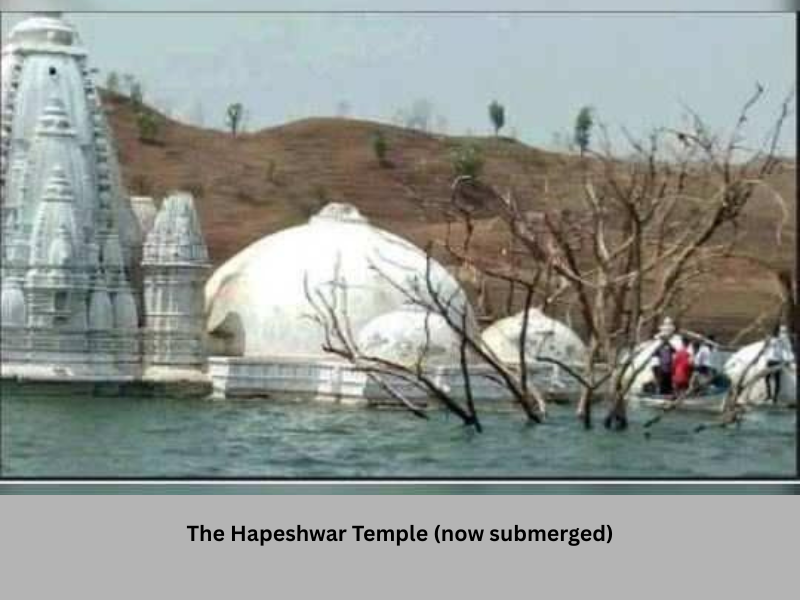
Coming back to the theme of important pilgrim places, the first major one in Gujarat is Hapeshwar on the northern bank in Chhota Udaipur district. The Hapeshwar temple has got submerged in the dam but its ‘Shikhar’ gets visible at times. Due to lower water levels in 2018 a large part of it became visible after more than a decade. The name ‘Hapeshwar’ according to eminent scholar-saint Shastriji Maharaj of Nemawar, was ‘Aapeshwar’ meaning ‘God of water’ – ‘Aap’ meaning water in Sanskrit. As the name suggests the place is related to Varuna, the Lord of water. It is also referred to as Hanseshwar.
A fine new Hapeshwar temple has come up just beside the backwaters in Chhota Udaipur district, about 18 km from the town of Kavant, though one has to take a detour from the present Parikrama circuit to reach it. Most Parikramvasis walking on the northern bank proceed straight from Kavant into Alirajpur district of Madhya Pradesh through villages of Chhaktala or Bakhatgarh. But those who take this detour are amply rewarded through the serene ambience where the new temple of Hapeshwar stands with an ashram that serves Parikramavasis. The road to Hapeshwar from Kavant passing through villages of Karipani is kaccha in most patches and narrow, making its course through the hills and forests.
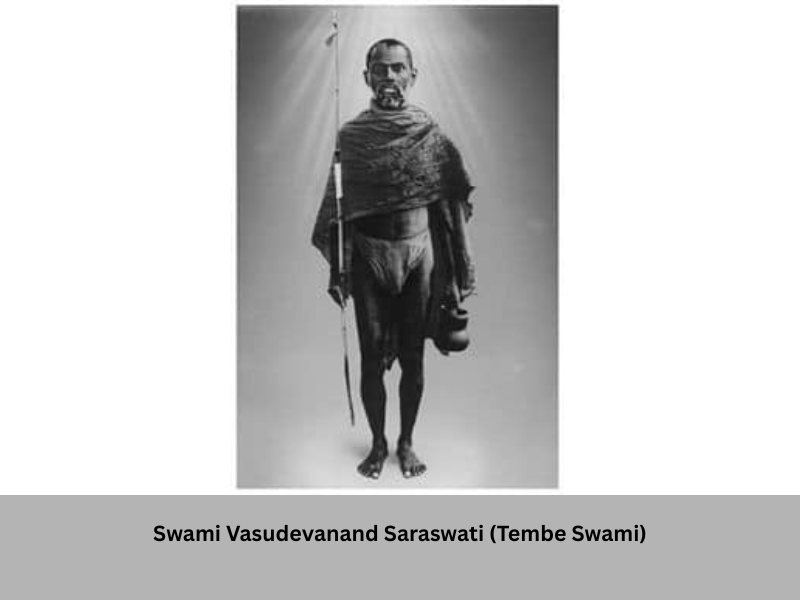
Further downstream on the northern bank is located Garudeshwar (where Garuda is said to have done Tapasya for Lord Shiva). It is near to the town of Naswadi and ‘The Statue of Unity’ and comes in ‘Narmada’ district. The place is of remarkable importance in the Narmada circuit, chiefly because of being sanctified by long years by the great saint – Swami Vasudevananda Sarswati, also known as Tembe Swami. It also has a Datta Mandir and place of Samadhi of this great saint. His presence led to Garudeshwar becoming one of the foremost Teerthas in the Narmadakhand. He popularised the glory of Narmada and Narmada Parikrama far and wide. Countless persons in subsequent generations have been inspired towards Narmada Parikrama owing to him.
Swami Vasudevananda Saraswati was born in 1854. He travelled all across the country as a Parivrajak (wandering monk) for 23 years before coming to Garudeshwar which was a heavily forested area at that time. He was a devotee of Lord Dattatreya. He had many disciples who were great spiritual teachers themselves. Sri Vasudev Saraswati was a great scholar in Sanskrit and wrote a number of books in that language. He had a great gift for composing verse in Sanskrit. Some of his most celebrated books are Dwisahasri Gurucharit, Datta Puran, Datta Mahatmya and Saptashati Gurucharitra Saar. He laid down his body in 1914 after predicting the date of his departure. He sat in meditative posture and chanting Om left his body.
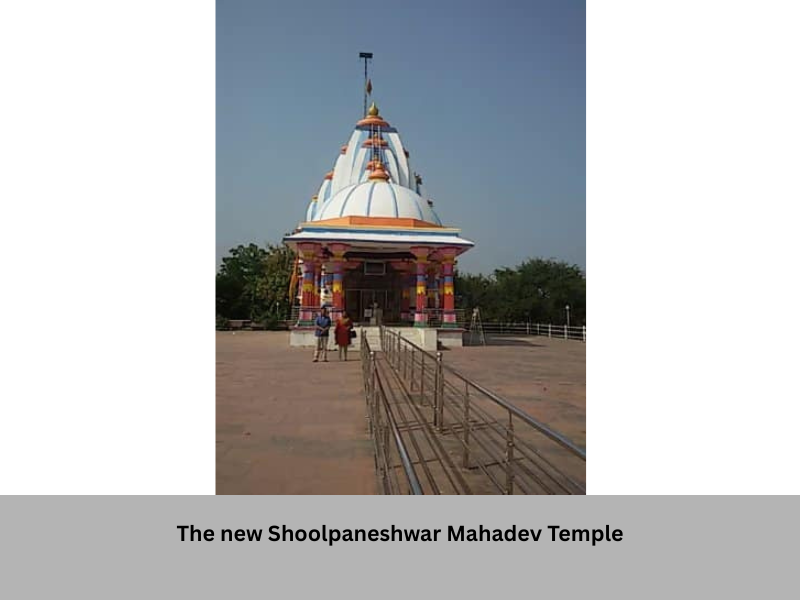
There is a highway bridge just downstream of Garudeshwar at a place called Akteshwar (which in earlier times was called Agastyeshwar after Rishi Agastya. The newly built Shoolpaneswar Mahadev (the original being submerged in the dam backwaters) is also near Garudeshwar but on the opposite (southern bank) near the village of Gora, few miles from the Statue of Unity. There are several ashrams now near the new Shoolpaneshwar Mahadev temple. A prominent one is Anand Ashram at Vasantpura, a few miles away, set up Swami Viyogananda, a much revered saint in Narmadakhand, who also developed the magnificent Shiva Karuna Dham complex near Handia, opposite to Nemwar. Swamiji is a great ascetic in nature and has spent long years of Sadhana in the Himalayas and in Chambal region. He has also set up an ashram in Gangotri called the Ishawasya Ashram.
About ten miles from Garudeshwar on the same bank is the town of Tilakwada which too has temples and ashrams.
Tilakwada was also sanctified by the presence of Swami Vasudevananda Saraswati and also has a Hanuman Temple said to be constructed by Swami Ramdas, the Guru of Shivaji. Tilakwada has also been the base of Swami Atmakrishna who has done Parikrama a few times and has authored valuable handbooks for Parikramavasis, particularly incorporating the changes in routes after the coming up of several dams.
On the southern bank, quite close to each other are Indreshwar amd Varuneshwar followed by Rameshwar, Lakshmaneshwar and Hanumanteshwar.
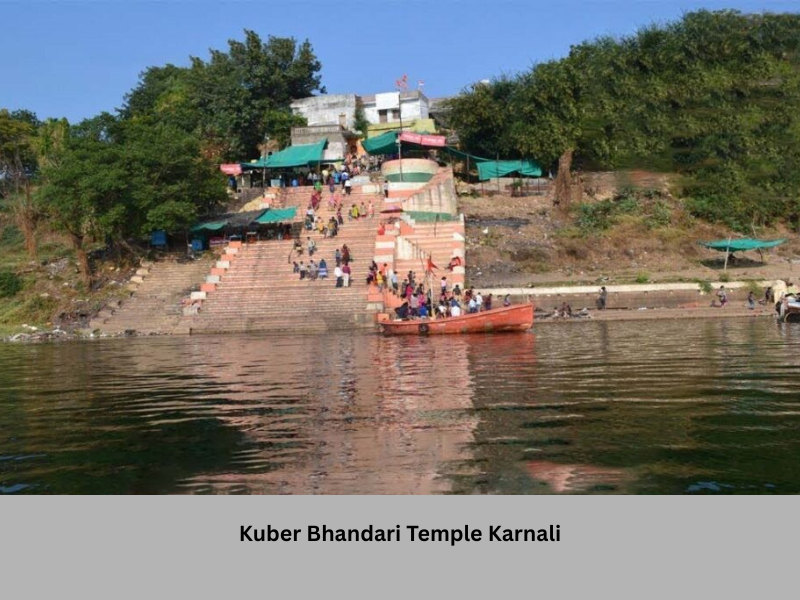
The next district on the northern bank of the trajectory is Vadodara (Baroda) while the district of Narmada continues on the south of the river. Though the city of Vadodara is about 50 km north of the river the district has very important places like Chandod and Karnali, also known as Dakshin Prayag, and has a Triveni Sangam of Narmada, Orsang and Saraswati. The Orsang river originates from Madhya Pradesh and flowing through Chhota Udaipur and Vadodara it meets Narmada here. The Chanod-Karnali area is considered sacred for conducting the ‘Shraddha’ rites . There are a number of temples and ashrams in the area. A big Kuber Bhandari temple has also come up here and on the southern bank is the Swami Narayan temple.
Immediately downstream of Chandod, on the same side, comes Gangnath and a little further downstream it is Nandikeshwar. It is said that the great river Ganga herself comes to take a holy bath in Narmada once a year at Gangnath-Nandikeshwar area on the day of Vaishakh Shukla Saptami. This area is thus considered to be very sacred.
In Gangnath, lived the great Yogi Swami Brahmananda, who was said to have seen many a century in his lifetime. Sri Aurobindo (while serving in the Baroda state ruled by the highly progressive Sayaji Rao Gayekwad) often visited him during the years of his stay in the area between 1893 and 1906. His younger brother, the radical revolutionary, Barindra Ghose, and also some of his friends often frequented this area and were charmed by it. Sri Aurobindo had so much fascination for the area that keeping this location in mind he had conceived his ‘Bhavani Mandir’ scheme (an ashram where all-renouncing patriots would live and work towards freeing their country) for which he penned down a pamphlet of the same title. The impress of Bankimchandra’s Anandamath is unmistakable in the concept of renunciate-patriots as well as viewing the nation as Devi, the Mother Goddess. The project as visualised, however, did not take off, though a school training the patriots, away from the eyes of the colonial masters on account of its remote location in a princely state not directly under the British administration, is said to have been run there for some time.
At Chandod also lived another renowned Yogi, Sri Balananda Brahmachari, who later founded an ashram in Deoghar in Jharkhand, with considerable following in that part of the country, and Bengal in particular with his tradition continued by his disciple Sri Mohananda Brahmachari.
Rajpipla State and the remarkable Maharaja Vijaysinhji
The first three districts in Gujarat through which Narmada flows are Chhota Udaipur, Vadodara and Narmada (having its headquarters at Rajpipla.) Most part of Vadodara is on the northern bank while Rajpipla is mostly on the southern. Both Vadodara (Baroda) and Rajpipla were also important princely states prior to independence. The Rajpipla state ruled by the Gohil Rajput dynasty for nearly six centuries had a much longer history than its admittedly more powerful northern neighbour – and often a challenger – the Maratha state of Baroda ruled by the Gaekwars. While the history and achievements of the Baroda state, particularly during the reign of its later progressive rulers like Sayajirao Gaekwad has been much written about, the story of the Rajpipla state is not that widely known.
The Rajpipla state had its seat of power at the town of Rajpipla on the bank of river Karjan, a tributary of Narmada. They had as their Kuldevi, Mata Harsiddhi Devi of Ujjain, and a temple dedicated to the Devi is also located in Rajpipla town. Founded in 1340, the Gohil Rajputs dynasty of Rajpipla only came to be seriously challenged for a short while when the Maratha state of Baroda began to extract tribute in the beginning of the nineteenth century. The emerging British supremacy completely changed the power equations in the whole region, as they did in most parts of the country. But during the 1857 struggle, the Maharaja of Rajpipla rebelled against the British and later had to pay the price (not heavy and unpleasant though) of being deposed and seeing his son replace him.
The last two rulers of Rajpipla, Maharaja Chhatrasinhji (ruling from 1897 to 1915) and Maharaja Vijaysinhji (ruling from 1915 to 1948) possessed administrative abilities of a high order. Chhatrasinhji laid the railway line in his state and was conferred the knighthood for his administrative accomplishments. Vijaysinhji had a wider array of interests and engagements, and even though on first look his ways appear to be like those of the usual self-indulgent and unabashedly anglophile rulers – a type that was not uncommon at that time – he had a marked disposition towards striving for the betterment of the conditions of his subjects and had a far-sighted vision that helped him execute several development and welfare-oriented projects that had a long-term bearing on the people of the region. He brought in land and revenue reforms that increased revenues while reducing the taxes on common folks, and did praiseworthy relief work during droughts and famines. The Maharaja could also see the potential of dams and conducted surveys for the same and in that respect anticipated the later big projects on Narmada.
He built several hospitals, instituted maternity care, and even started a veterinary hospital. He launched free primary education and created facilities for sporting excellence for youth. He himself was a sportsman at heart. He possessed the best racehorse stable in the subcontinent and his horses won some of the most prestigious races in the world like the Belgium Derby, the Irish Derby, and most significantly, the Epson Derby that was considered to be the greatest equestrian competition in the world.
While he usually spent summers in England he was never out of touch with the pulse of the rapidly changing situations back home. Even as a ruler he held elections for increased people’s participation and representation in affairs of governance – he starting holding elections to a legislative assembly as early as 1932. He led the consensus-building process among the native states of Gujarat on the crucial issue of accession to the Union of India. The Indrajit-Padmini Palace that he built is a fine architectural specimen of those times. He passed away in 1951 and was cremated on the bank of Narmada near Rajpipla, with his death being deeply mourned by the people of the region.
Sinor and Malsar
The town of Sinor is located on the northern bank in Gujarat after Tilakwada. It is the birthplace of eminent Gujarati literary figure Ramakant Vasantlal Desai who by his voluminous corpus of work, in the first half of the twentieth century, through novels, short stories and poems enriched the literature in that language in a significant way. The town also has several temples.
About three miles downstream on the same side of Sinor is yet another important place of Malsar. It has a number of temples and ashrams, including one of the renowned saint Sri Madhavdasji. Malsar is also known for its association with Sri Ramachandra Keshav Dongre ji Maharaj, who was nationally famous as a Katha-Vachak of Srimad Bhagwatam. A householder, he used to donate all the proceeds of each of his ‘Katha’ to some humanitarian or social cause. There have been several Annakshetras in the Narmadakhand started by Sri Dongre ji Maharaj. It is said that when the wife of this great man who had donated millions of rupees passed away he did not even have ready cash to do her last rites. Such was the way he had lived even with such vast following all over the country. Anyone who has listened to Sri Dongre ji Maharaj vouches for the profoundly unmistakable feeling that the whole ambience stood transfigured by his presence and all in the audience, even children, listened to him with rapt attention, as if under a spell. Sri Dongre ji Maharaj had his final resting place at Malsar on bank of Narmada.
▶Next Chapter: Towards the Sea