After Narmadapuram, on the same banks is located the village of Khoksar, the Samadhi place of Sri Gaurishankar Maharaj, whose role in popularising the practice of Narmada Parikrama had been very significant. Sri Gaurishankar ji Maharaj is said to have possessed great Siddhis (special powers) and Grace of ‘Narmada Maiyya.’ There are stories about him of how he would take Narmada-jal and have pooris made in that when there was no Ghee or oil available. There is a temple complex at the place and stay facility for Parikramavasis. A couple of miles ahead is the Tigadiya Ghat, again having a Dharmashala and a hall for Parikramavasis.
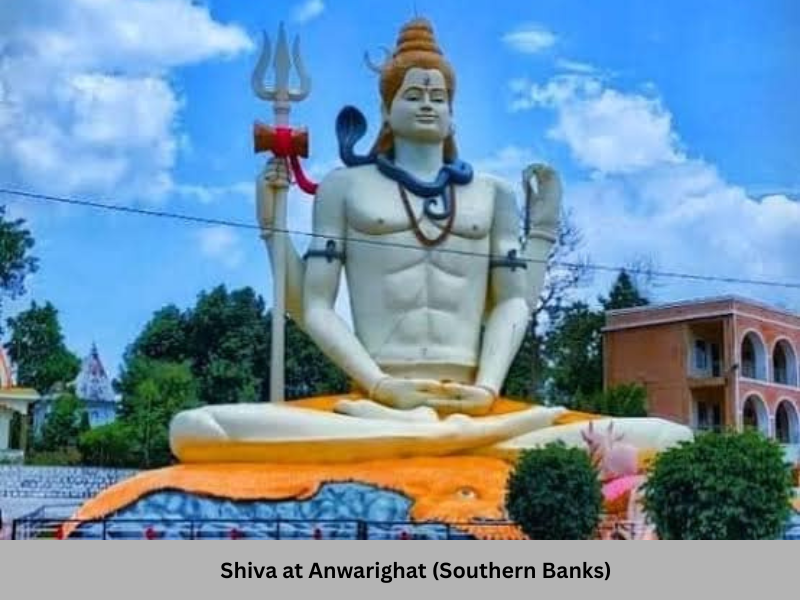
Further downstream, one reaches the Anwarighat, a very important ghat after Budhni on the northern banks – there is another ghat by that name on the southern banks as well. There is a wide road bridge connecting the banks here. The Anwari Ghat on the southern banks has a very large statue of Lord Shiva and several temples and ashramas.
It is said that wives of the Devas (at a time when they lost their domains to the ‘Asuras’ prayed to Parvati (the consort of Shiva) to redeem the earlier honour and possessions of their husbands. They received the boon and the Devas were restored to their earlier glory.
It is also said that Pandavas had stayed there and also set up a village called Hastinapur here. There is a still a village ‘by name of Hathnapur’ here, probably an allusion to the ancient Hastinapur. About 12 km north of Anwarighat, mounted on Vindhya hill-top, is the famous Bijasani Devi temple of Salkanpur, visited by hundreds of thousands during the year. Along with Maihar (in Satna district) and the Devi temple at Dewas, it is probably the most revered and most visited Devi temple in Madhya Pradesh. There are hundreds of stairs leading to the top, a trolley-car facility which gives a beautiful view, as well as a motorable road.
There are a few more well-known places having ashramas that serve Parikramavasis like the Bavari Ghat on both the banks and Chandgarh Kuti on southern banks. Just before Bavari, Narmada bifurcates into two streams, and forms a sizeably big sand island that it gives an impression of sea beach.
Also, a little downstream of Bawri, on the southern banks, is a large and beautifully constructed Ghat at Bhiladia. One has to climb down a very large number of stairs here. There are temples of Sri Rama and Lord Shiva here.
A little downstream on the northern banks is located Neelkanth, where the river Kolar river meets Narmada – the Kolar river, 101 km in length, has an extremely scenic dam and reservoir in midst of deep forests and Vindhya hills? just 40 km outside Bhopal city.
There are also ghats at Sheelkanth and Saatdev on the northern side. Opposite to Saatdev, that is on the southern banks, is a prominent place called Ganjaleswar Sangam which has a Math (monastic establishment) called the Gangeswari Math as well as several temples with a Triveni Sangam where Ganjal and Gomti meet Narmada. This small village, like countless others in Narmadakhand, is vibrant with the spirit of Narmada. The Gangeswari Math here is an old establishment and it has seen 10 pontiffs (Mahants). Their places of final repose (Samadhi-Sthal) is called a ‘Chhatri’ and thus there are ten Chhatris in the area. The Ganjal river also serves as the boundary between Narmadapuram and Harda districts. Like several places in Narmadakhand this place sees a number of fairs on special occasions. On Narmada Jayanti a Saari is offered to the Maiyya here, which is taken to the ither bank by several boats.
A little downstream on the northern banks is located the village of Chhipaner. Near Chhipaner, the river Seep meets Narmada and the has a prominent ashrama dedicated to the saint Dhuniwale Dadaji.
Opposite to Chhipaner is Chhoti Chhipaner (on the southern banks) and some distance away one reaches the village of Chichot, where the Bajrang Kuti is located. At this place a renowned Yogi of the region, Sri Bajrangdas lived. Later his illustrious disciple Sri Tilak Maharaj too had his base here. Sri Tilak Maharaj was a great scholar and a gifted polyglot and knew several European language. The Swami also authored several books, many of which are in genre of travelogues and memoirs documenting his experiences in foreign countries where he visited with little resources. The ashrama now has a nice Veda Vidyalaya that admits children of all castes, something that was not in practice earlier in most traditional Veda Vidyalayas. It also has a fine library, which was mostly the books collection of Sri Tilak Maharaj. Unfortunately, Sri Tilak Maharaj passed away in a road accident in 1980s when he still had years of active life ahead of him.
Further downstream, around a place called Jaloda on the southern banks, Narmada as it happens does not have much depth, except during the rainy season, and for this reason, this is where, it is said, that the Mughal armies used to cross over from north to south. It is also the Samadhi-Sthal of a highly revered saint who lived here, Ratiram Maharaj.
Just a little ahead of Chhipaner on the northern banks, one enters the district of Dewas leaving Sehore, with district of Harda (carved out of Narmadapuram) on the opposite banks. After crossing the ghat at Bijalgaon on the northern banks, one arrives at Turnal where the river Gauni meets Narmada. Though a very small village, it has great import since antiquity. It has a temple dedicated to Sri Parasuram, one of the Dashavataras (ten incarnations of Lord Vishnu) and Turnal is considered as a very important place for ‘Pinda-daan’, ‘Shraddha-Tarpan’ and like rituals for one’s ancestors. It was visited by the Dalai Lama in 2017. About a mile ahead is the small but nice ghat at Kundgaon and another mile ahead is the Samadhi of saint Atmaram who lived more than a century back. This place is particularly scenic with the rivulet Jamner meeting Narmada and hillocks with forests on one side. Just a mile ahead, one reaches the central point of the Narmada trajectory, equidistant from Amarkantak on one side and the sea on the other. This is the area of Nemawar-Handia, with Nemawar on the northern banks in Dewas district and Handia on the opposite banks in Harda district.
Nemawar-Handia : The ‘Nabhi-Sthal’ of Narmada
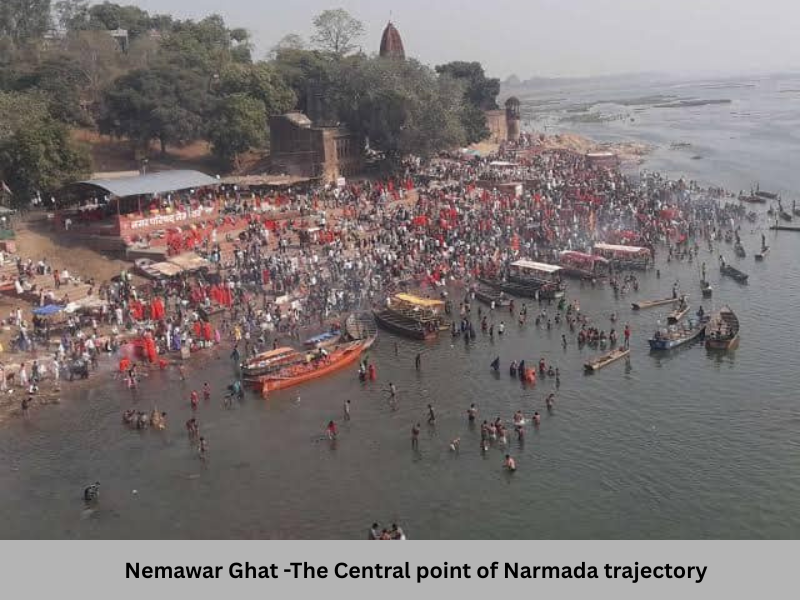
Since Nemawar and Handia are exactly the central point in Narmada’s course from Amarkantak to the sea, a small rock between the two banks, that remains above the water surface except during the rainy season, is called the ‘Nabhi-Sthal’ of Narmada. People go on boats to offer their worship at this place.
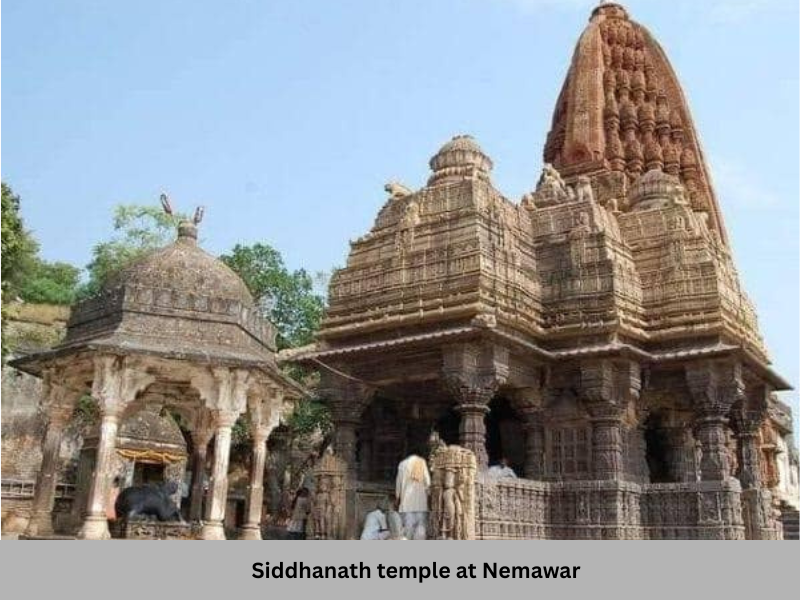
Nemawar is a place of great eminence in the Narmadakhand. It is said in the Vashishtha Samhita that the ‘Manas-Putras’ of Brahma – Sanaka, Sanatan, Sanandan, and Sanatakumar had performed rigorous Tapasya at Nemawar and given Upadesh (spiritual counsel) on the four ashramas (phases) of human life to sages assembled there. It has the ancient temple of Siddhanath. There are temples of Sri Ganesh seated between Riddhi and Siddhi, and a temple of Kaal Bhairav. Scholars specialising in studying temple architecture have surveyed the design of the Siddhanath temple and date in around the end of first millennium. However, in Indian tradition it is the place which has importance and its own age, temples are built are rebuilt in different ages. One legend is also associated with Pandavas and Kauravas in building this temple. One would never know for certain as to how many times it was built and rebuilt. But the place of Nemawar is mentioned in some ancient texts and Sanaka-adi (Sanaka and other three Manasputras of Brahma) are associated with it, the place is decidedly from great antiquity.
On the opposite bank at Handia is the temple of Riddhanath, and it is said Kuber had done Tapasya here after being displaced by his step-brother Ravana from Alkapuri. He later won it back. Sri Parashuram’s father – Rishi Jamdagni, and his mother Renuka Devi are also said to have lived in Nemawar. There is a temple dedicated to Renuka Devi in the village. Ahilyadevi Holkar did much for the temple at Nemawar.
Nemawar is the place where two greatly revered Mahatmas of Narmadakhand in recent memory, Brahmachari Viswanath Chaitanya commonly known as Brahmachari Maharaj) and Sri Lakshman Yogi, known as Mungphali Baba, stayed. Both had come to the region from South India. They were widely revered among devotees and Sadhu-Samaj alike. There are several small ashramas and Annakshetras in the area. At Nemawar, the Chinmay Dham ashrama (the place where Brahmachari Maharaj lived) serves and accommodates Parikramavasis. Near Handia has come up a prominent complex called the ‘Shiv Karuna Dham’ with a beautiful temple started by Swami Viyogananda. For last few decades a widely regarded saint and scholar Sri Shastriji Maharaj who belongs to the Sri Sampradaya of Sri Ramanujacharya, has also been living in Nemawar at ‘Bade Baba ashrama’. This ashram has big celebrations during Janmashtami, Guru Poornima, and Narmada Jayanti. There is also the Khak-Chowk ashram, a branch-line of the Ramananda Sampradaya, located here. It has a very old Hanuman idol. A very old ashrama called ‘Aloni Ashrama’ (probably named after one Aloni Baba, meaning one who did not take salt) is located and said to have been supported by Ahilyadevi Holkar at one time. It is now called the Dandi Swami Ashrama where a Sansyasi with considerable scholarly reputation, known as the Dandi Swami is based.
There is also a huge Jain temple complex near Nemawar. It was being built for nearly two decades. Opposite to it is a big Dharmashala and Jain monastery. The inspiring force behind the whole development of the complex was the internationally revered Jain Muni Sri Vidyasagar ji Maharaj (known among devotees as Acharya Sri.) It is said that many great Jain ascetics in the distant past had done Tapasya in the Nemawar area and attained great heights in their Sadhana. So this area is regarded as a Siddha-Bhumi for Jains too.
Local people claim that a few centuries back Handia, opposite to Nemawar, was a vibrant town and noted as a manufacturing hub of brass utensils. In addition to its hoary Hindu heritage it also has marks of Islamic influence during the medieval period. There are a number of tombs in this region. A prominent one is that of Mulla-Do-Piaza, who was believed to be one of the Nav-ratnas (nine gems) in Akbar’s court – a witty courtier, often portrayed as Birbal’s rival. There is also site called ‘Teli ki Saray’ – sort of a medieval hotel with Islamic architecture. It is now under the Archaeological Survey of India. It has numerous small rooms. This site further reinforces the notion that Handia had been a trading centre in the past and many travelling tradesmen visited and stayed there. Just a couple of miles south of Handia is a temple atop a hill dedicated to Shiva called Hindolnath. There are marks of Trishul made of vermilion at this place. Throughout the night the lights on the hill remain lit up which make a beautiful site and can be seen from a distance of many miles from all directions.
It is said that Nemawar was said to have been called ‘Nabhapur’ (owing to being the ‘Nabhi-Sthal’) of Narmada, and Handia as ‘Pattanam’ in bygone times. The area to together was referred to as Nabhipattanam.
Beyond Nemawar-Handia
Just downstream of Handia one encounters a series of Satpura ranges though the Vindhyas on the north recede slightly afar. Here the old Parikrama route on the southern banks that went through Seegone, Uchawan and Joga is no longer used and one has to take a circuitous route around the backwaters of the huge Indira Sagar Dam. However, there are some very scenic locations and ghats on the old route now in disuse. There are villages of Gawla, Maida and Seegon leading to Uchawan. Each of them has beautiful banks with hills and forests bordering on them. Opposite to Seegone is Rajaur Ghat which has a temple with an idol of Narmada Devi. Just before it, opposite to Maida is the Bagdi Sangam, an ancient place finding a mention in the Puranas. It is also called a Bhairav Siddha Kshetra and the place of union of river Bagdi with Narmada.
On the northern banks one can almost go on the side of the river through villages of Navada, Bajvada, Mandaleswar, Rajaur, Tamkhan and Melpiplya. At Bajvada lived a great saint called Tatambari Baba, and the villagers have built a temple in his honour. The Bagdi Sangam is a mile downstream of Mandaleshwar and both these places have ashramas where Mahatmas stay. The Bagdi Sangam also has a nice ghat.
Near Joga on the southern banks (in Harda district) – opposite to Fatehgarh, there is a small island on Narmada having a fort, called the Joga fort, built by a Gond king. It can be approached by a boat from Joga. The place is under the Archaeological Survey of India and board indicates that it was once held by Aurangzeb. This area was also known as Joga-Fatehgarh to Parikramavasis of a previous generation and still called by that name to the local people.
A little ahead of Joga-Fatehgarh, around 25 km downstream of Nemawar-Handia, start a series of dams that have permanently changed the geography of the region. The Narmada has changed more in last forty years than it perhaps did in preceding forty thousand years or more. The first major dam one comes across is the Indira Sagar Dam, earlier known aa the Narmada Sagar project. Its construction was inaugurated by Prime Minister Indira Gandhi just a week before her assassination and later named in her honour Though the Indira Sagar dam is located in Khandwa district its backwaters flow into districts of Harda and Dewas.
The costs and benefits of dams have been widely debated and this is not the space to bring that in. But certainly one sad outcome is the loss of several sites of traditional importance to the Parikramavasis and other devotees in general. About a hundred villages and entire town of Harsud, got submerged in the Indira Sagar project. The rehabilitated township called ‘Naya Harsud’ is at Chhanera on the rim of the backwaters. A segment of the Harda-Khandwa section on Bhopal-Mumbai railroad had to be removed farther away because of the backwaters.
The Indira Sagar has a hydel project under the National Hydel Development Corporation, and also a thermal power plant called Singaji Power Plant – which also uses the water of the dam. The Indira Sagar project has the distinction of having the largest volume of water in its reservoir among all the dams in the country. The township establishment for the dam is called Narmadanagar and is near the Tehsil headquarter of Punasa in Khandwa district. Before the Parikrama routes got changed one had to go through dense forest infested with wild beasts known as the ‘Omkareswar Jhaadi.’ Now a Parikramavasi has to circumvent the entire Indira Sagar reservoir on the southern banks almost after Handia and for many days (even for more than a week) is unable to get a sight of Narmada. One passes through Ratatalai, Sontalai, Khirkiya in Harda districts, and enters Khandwa district through Chhanera (Naya Harsud), and crosses another major left-bank tributary called ‘Chhoti Tawa’ and after Mundi, and finally reaches the southern banks of Omkareshwar through a loop which has significantly added to the length of the Parikrama circuit.
On the northern banks, however, the route has not changed much. One has to still pass through deep forests immediately after the village of Pamakhedi. This patch called the Lakkadkot jungle has forests for around 1000 sq km with no human habitation. The perils of the wild are always present in these areas. Earlier, as recent as a couple of decades back, one could even get lost as there were no paths (pagdandis), let alone any pavement or road. There had been anecdotes of people unable to find their way out of the Lakkadkot for days together. On the northern side, a certain narrow stream had to be crossed around twenty times. One had to keep a count to be sure that one is moving ahead in the right direction.
Now a network of kaccha roads run through the Lakkadkot, chiefly towards Jayanti Mata Mandir which is the nerve-centre of this area. One can only see forests as far as one’s sight can take. One wonders how a temple came into existence in such an inaccessible, perilous, and uninhabited area. But then in a land of faith, that India is, there is no dearth of such bewildering instances. The Jayanti Mata Mandir is visited largely by the tribal communities living in tehsils of Udaynagar, Bagli, and Satwas in Dewas district, and Punasa tehsil of Khandwa district. The people usually visit in two wheelers, rented jeeps, or tractor-trolleys – the last mentioned is the most common vehicle in rural India. It is the poor Indians’ SUV and can accommodate dozens of persons. It can be highly dangerous because of poor balance and numerous accidents are reported every year by overturning of these trolleys.
Just half a mile down from the Jayanti Mata Temple, gingerly walking through a stony path, one reaches a water stream with water flowing down the rick ceiling of a cave called the ‘Bhairav Gufa.’ All visitors to the Jayanti Mata Mandir visit this place too.
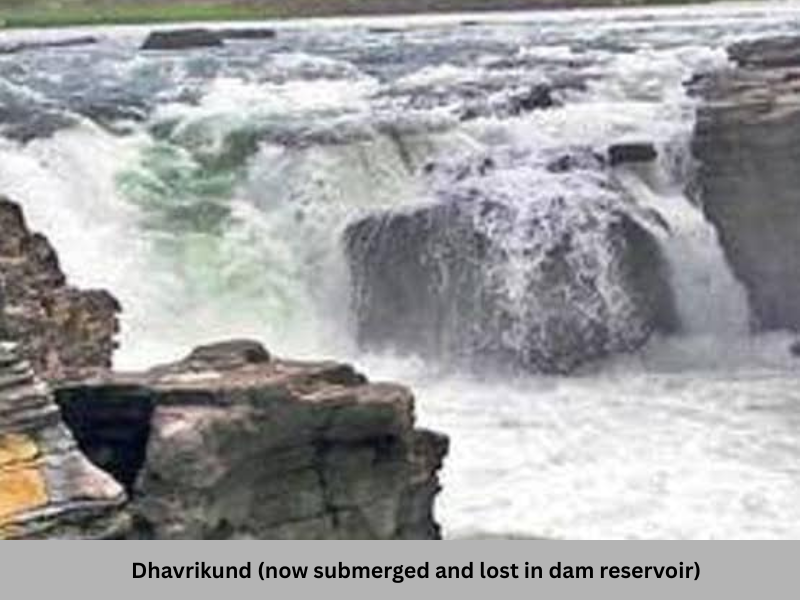
Further westward of the Jayanti Mata Mandir, across the forests one reaches Sitavan. This marks the end of the Lakkadkot. Here is a temple and Kund (water body) and it is believed that Sita ji, along with her sons Lav and Kush had stayed at this place in the Ashrama of Sri Valmiki, the great sage and author of the Ramayana. The place is located near the village of Peepri in Udaynagar tehsil of Dewas district, and is on a good motorable road from Udaynagar and Punjapura, taking a detour on the road to Badwah which further takes one to Khandwa and Khargone. The temple is called the ‘Sita Mandir’ where Sri Ramachandra, Sri Sita ji, Sri Lakshmana, Sri Bharat, Sri Shatrughna, Lav, Kush, and Sri Hanuman along with some other characters of the Ramayana are worshipped. The Narmada flows about 5 km from this place and can be approached in the area known as Dharaji at which place were once located the famous waterfalls on the Dhavrikund, now lost for ever in the backwaters of the Omkareshwar dam. The Omkareshwar dam reservoir, located a few miles before Omkareshwar, has taken in itself the Dhavarikund, which earlier had several small waterfalls and considered as a very scenic area. The Dharaji area was also famous for its natural Shiva-lingas, known as the Bana-lingas.
A new Dharaji Ghat is being developed here near the village Jamli. From this ghat one can see on the other side the temple of Baneshwar Mahadev amidst dense forests on that side too.
Before the submergence of this area, local expert divers used to fetch Banalingas from the depths of the river. These Banalingas adorn innumerable Shiva temples and home-shrines of devotees all over the country. The greatest Chola king, Rajaraja Chola, who lived a thousand years ago, took a Banalinga from Dhavari-kund to the great Brihadeswara temple he built at Tanjore following a great victory campaign.
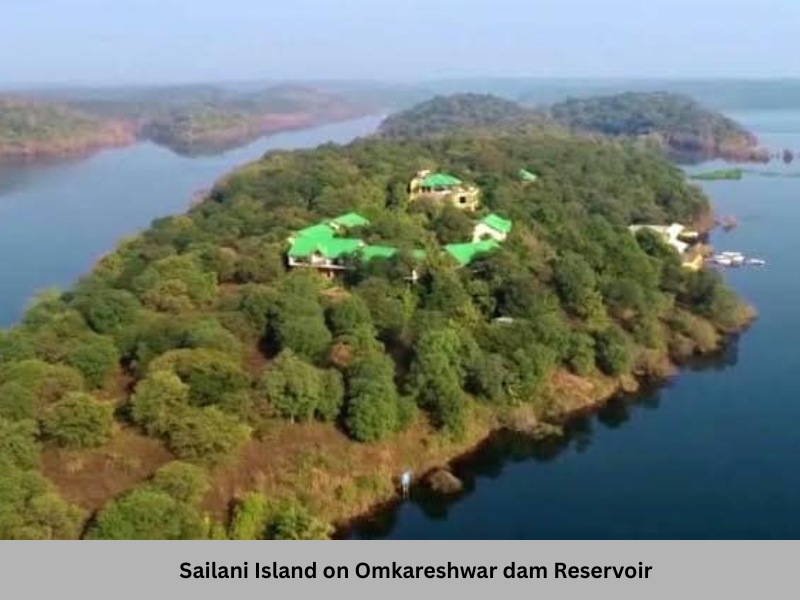
A very significant spot called Choubees Avatar, located just opposite to the Omkareshwar island, has been submerged in the Omkareshwar dam. A grand Jain temple called Siddheshwarkut is very near to the Omkareshwar dam establishment which is run by National Hydel Development Corporation. The MP Tourism has also developed a tourist resort in the Sailani island in the Omkareshwar dam. A little upstream of the Omkareshwar dam and a few miles north of Narmada is the Chyavan Ashram. It is in a dense forest region and it is said that Rishi Chyavan, son of Rishi Bhrigu, stayed and did his Tapasya here. It has a big Goshala. A little westward of Chyavan ashram is the Khedighat region which has numerous ashramas like the Dolari ashram followed by Charukeshwar, where the river Choral meets Narmada, and one is finally led to the tehsil town of Barwah on the Indore-Khandwa highway.
Because of the dams, as already mentioned, the traditional Parikrama routes have changed significantly.
On the northern banks one usually goes from Barwah and Khedighat region on the Indore-Khandwa road (near Omkareshwar) and proceed from Charukeshwar, Chyavan Rishi Ashram, Dharaji, Sitavan, Jayanti Mata Mandir and through the Lakkadkot jungle to Pamakhedi. One then walks on the road to Dharmeshwar Mahadev. This temple is situated at a beautiful place with trees aplenty offering respite even from the scorching summer sun. From there to Fatehgarh. One then crosses the river Datuni to reach Melpiplya and through Rajaur and Bagdi Sangam walk towards Nemawar.
On the southern banks after Handia, one has to take, as already mentioned before, quite a circuitous route. The Parikramavasis going seaward have to walk around the whole reservoir. The Samadhi-sthal of great medieval saint Singaji, highly revered in this region of MP, is located here. It is connected by an isthmus-like path well into the dam reservoir. The Samadhi-sthal would have come under the backwaters but using technology the whole structure was elevated to a much greater height and thus it is still the same structure at the original place, only at a greater elevation. Another place in the region which has been developed as a tourist attraction is the Hanuwantiya island on the periphery of the Indira Sagar reservoir. After a place called Mundi, after Chhanera, in Khandwa district, one goes to the southern banks of the Omkareshwar island.
Dewas : The Hill of the Devi
Guru Govindsingh had visited Indore, and crossed Narmada through Nemawar-Handia. He is supposed to have stayed at Handia and a writing of his is said to be still preserved in Handia. He had also passed through a small town of Kantaphod near the dense jungles in the Vindhyas in Dewas district on the northern banks. At Kantaphod, there is a temple where there are idols of Narmada Devi, Hanumanji, as well as that of Guru Govind Singh. A grand display-board outside the town declares itself as ‘Guru Govind Singh ki Nagari’ – ‘Town of Guru Govind Singh.’
Incidentally, both Kantaphod, as also the prominent pilgrim village of Nemawar are in Dewas district. It was in Dewas that the great English author E.M. Forster, who had been nominated for the Noble Prize in 20 different years but never won it, lived for about two years around 1921-22 working as a private Secretary to the local ruler Tukojirao III.
He had written a work titled ‘Hill of the Devi’ – alluding to the Devi temple at the hilltop in Dewas. He also used his Dewas experience quite dexterously in arguably his most famous work ‘A Passage to India’ published in 1924, though he had begun writing it in the pre-war years when he had first travelled to India.
Forster’s work is ranked among hundred greatest novels in the history of literature. Forster took the title of the book from the great nineteenth century American ‘Transcendentalist’ poet Walt Whitman’s poem
titled ‘Passage to India’ which had appeared in his collection ‘Leaves of Grass’.
Incidentally, Whitman is said to have been influenced by the Indian streams of thought, most notably the Vedanta philosophy, and did not fail to emphasise both the immanent and transcendental nature of divinity, thus coming within a striking distance of the essence of the Vedantic thought.
The present writer has spent months together in Dewas district and can vouch for the fact that few people in Dewas or even the nearby bigger city of Indore would know of Forster’s presence in the area, that gave him the inspiration as well as the material for his great literary work, or even the title ‘Hill of the Devi’ that directly alludes to the Devi temple. But then countless footprints are impressed upon the sands of time, across the ages, in the Narmada region, and one feels that it is a high honour even for a figure like Edward Morgan Forster to be marked as a footnote in the story of Narmadakhand, even though one is not certain of the extent to which he might have been aware of the unique cultural ethos that ran through this region of Narmadakhand since antiquity.
▶Next Chapter: Omkareshwar: The Crest-Jewel of Narmadakhand